


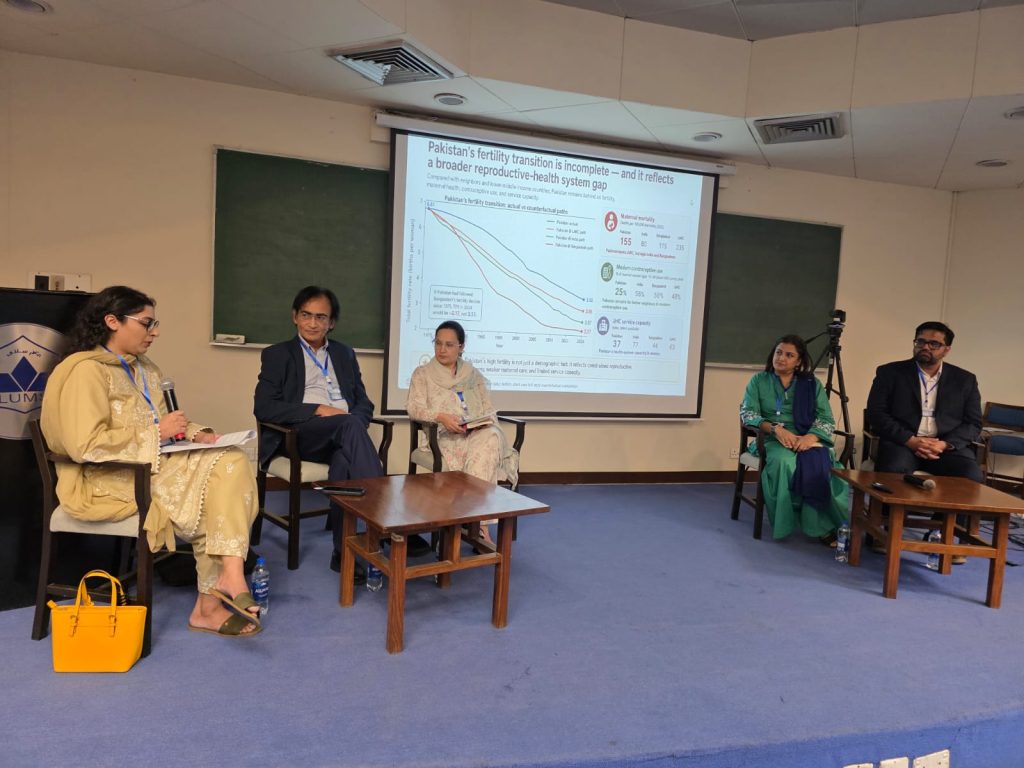
karachi: Experts at a Gender & Economy Conference warned that emerging technologies such as artificial intelligence (AI) could either significantly expand economic opportunities for women or further deepen existing inequalities, depending on access to education and digital skills.
The panel discussion on “Health & Gender” was moderated by LUMS faculty member Warda Riaz and featured contributions from experts including Fyeza Jehan, Usman Ali, Adnan Khan, and M. Farhan Majid.
Speaking during the session, a panelist emphasized that women’s economic empowerment is closely linked with their capabilities and bargaining power, arguing that low-cost learning opportunities and digital skill-building initiatives could help women overcome structural and non-economic barriers.
The discussion highlighted how faster access to information and digital tools is reshaping small business operations globally. Referring to survey findings conducted in collaboration with the Asher Blair Foundation, the panelist noted that women entrepreneurs from around 80 countries showed strong interest in integrating generative AI into their businesses, particularly for functions such as accounting, payroll management, and other routine administrative tasks.
According to the discussion, AI has the potential to significantly transform how women-led enterprises operate, especially by reducing time-consuming manual processes and improving efficiency.
The panel also referenced estimates suggesting that Pakistan’s women-centric digital economy could represent a potential market worth approximately $500 million, based on an estimated 73 million women population, underscoring the scale of untapped economic opportunity.
However, the panelist cautioned that Pakistan’s ability to benefit from AI-driven transformation remains constrained by low levels of education, literacy, and human capital. Without targeted intervention, they warned, technological advancement could reinforce existing inequalities rather than reduce them.
“There is a risk that communities with lower skills will be unable to benefit from new technologies,” the discussion noted, adding that countries failing to invest in digital capacity-building may fall further behind globally in productivity and competitiveness.
The panel further stressed that unequal access to technology could have broader macroeconomic implications, potentially pushing economies toward lower productivity and higher reliance on imports, while more digitally advanced countries continue to scale efficiently.
Concluding the discussion, speakers called for urgent investment in women’s digital education, arguing that inclusive access to AI and technology-driven skills development is essential to ensuring equitable economic growth.